2118 SW Broad St., Hoxie Arkansas
Please set up an appointment prior to visit
We could be in the field!



HOXIE
Arkansas
Water Hog Inc.
Hybrid Flight Master Pump Curves
Hi Rick,
Thanks for reaching out to discuss the NPSH performance of your pump. I started looking into this and would like to make some general comments and recommendations.
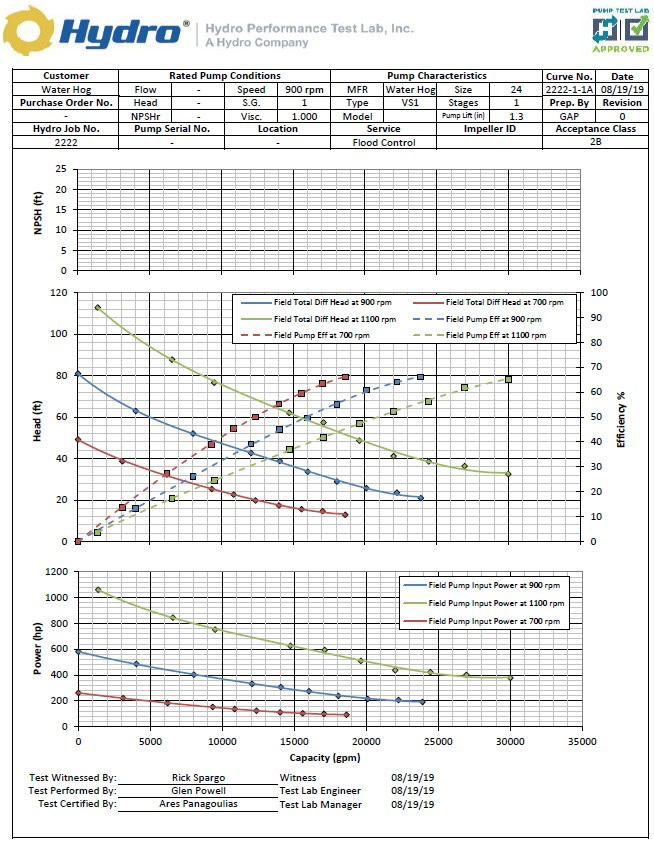
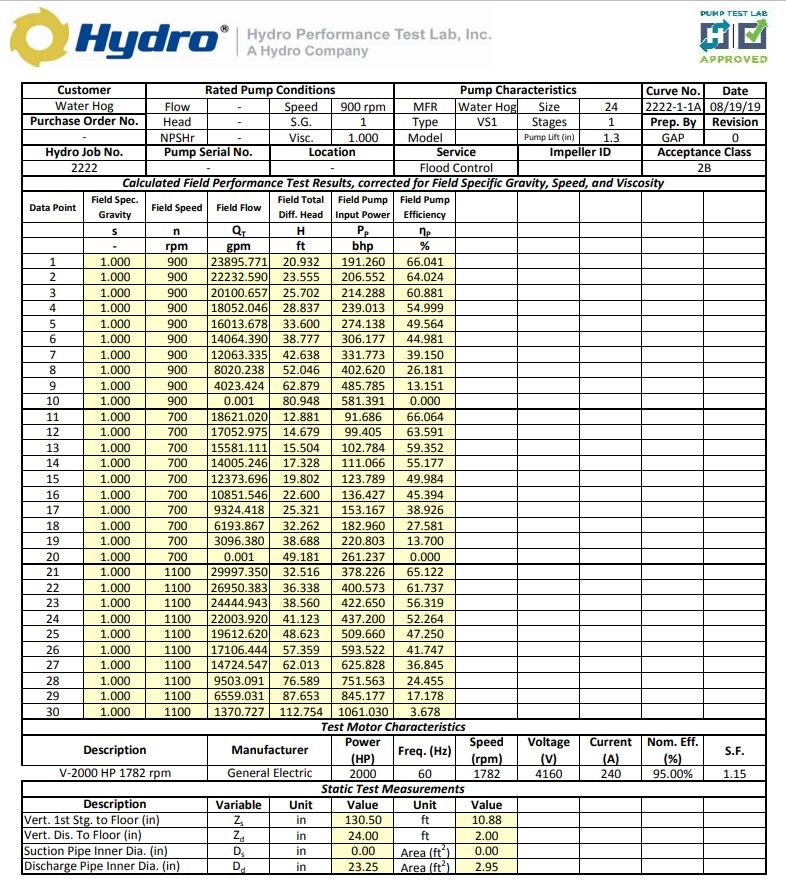
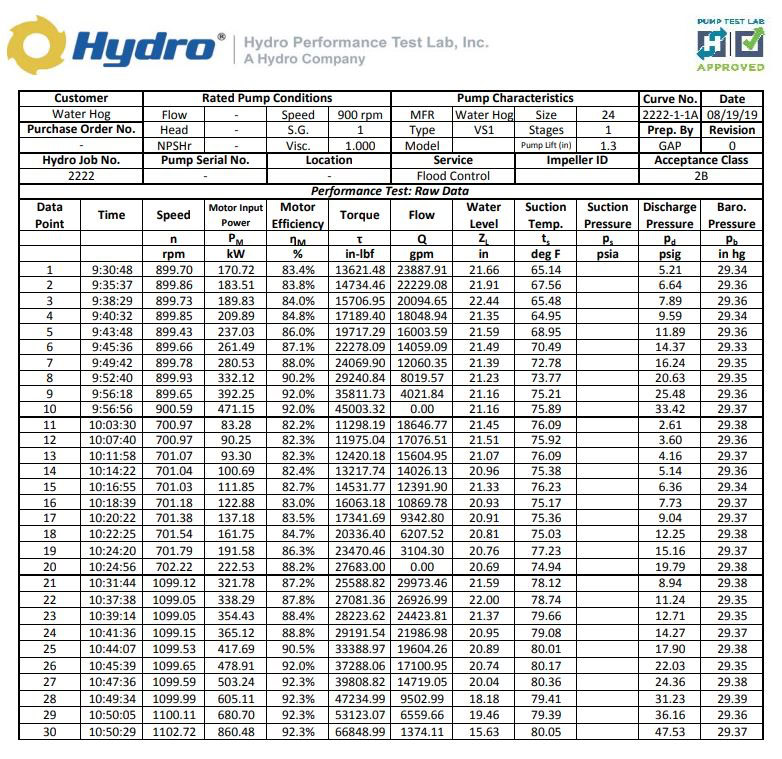
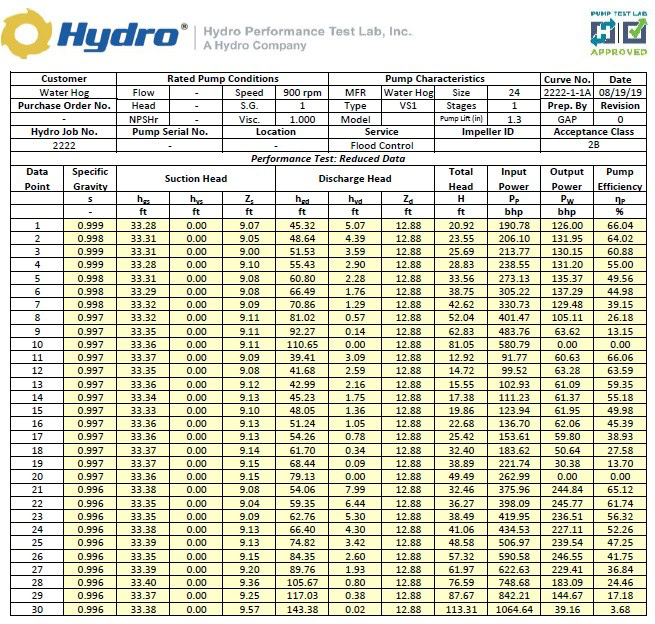
As you will see attached, I included an appendix that expands out the data from your test curve 2222-1-1A, which gives you an idea of the NPSH available during the test. This NPSH available is essentially the suction pressure due to the atmospheric pressure (about 33 ft) and the submergence level of the pump (about 9 ft, Suction Head Zs in the original report). The resulting NPSH available during the test is about 41.5 ft throughout the testing. At no time during the testing of the pump was cavitation observed. So, at the very least this 41.5ft is an upper bound for the NPSH required. In other words, we know from the testing that the value of NPSHr will be below 41.5 ft at all speeds and flow rates we tested. This is a kind of benchmark value.
IF you were to go down the route of testing this pump to establish the NPSHr, here are some further details. In order to perform an NSPHr test on a vertical pump of this type, the test lab would be required to create a special fixture that would allow for the suction pressure to be reduced in a controlled way. Reducing the suction pressure in a controlled way allows for the NPSHr limit to be approached slowly and establish the limit at each flow rate. This limit is then used the draw the NPSHr curve. Vertical NPSHr testing at the lab is usually achieved by attaching an additional pipe to the suction of the pump and throttling the flow going into this suction pipe with a valve at the foot of the pump (under the water). This procedure is not typically done by the test lab for pumps of this type owing to the very low levels of submergence/NPSHA that are required for successful operation. For your pump in particular, this would be a very challenging test to successfully perform even with the required fixtures due to the high flow rates and low discharge head that are developed by the pump. In order to test the NPSHr at max flow, you would be looking for a 3% drop in the total developed head, but in your case that would only be a drop of 1 ft from 32.5 ft to 31.5 ft (a 3% drop). A 1 ft drop would be extremely challenging to measure accurately and repeatably due to the margin of error of the instrumentation used for the testing. At lower levels of TDH with high flow rates it just becomes very challenging.
The following will hopefully show why this is not typically done:
The NPSHr can be empirically estimated using a variety of correlations that are often referenced in pump design, one such estimate is given by Gongwer, and based on that estimate I calculate the following NPSHr:
25 ft-32 ft of NPSHr at maximum flow, at 1100 rpm
This data point was chosen as it is the most demanding and will require the highest NPSHr of all points tested. All other points tested will have estimated NPSHr values below this.
Since atmospheric pressure will typically be 33-34 ft, you can see that the expected level of submergence needed to run the pump would be 0 ft or less. For a machine such as yours that operates on an open sump, you will always have atmospheric pressure contributing to the suction pressure, and so will always have at least 33-34 ft of NPSHA even with very little or no submergence. This is of course only an estimate based on an empirical correlation, but it gives you an idea that it just doesn’t take much NPSH available to run a pump like this.
Please let me know if that is all making sense, and I hope that can be of help to you. Feel free to reach out if you want to discuss further.
Best Regards,
Glen Powell
Reliability Engineer
Hydro Reliability Services